
PROGRAM OVERVIEW
The Office of Drinking Water (ODW) created the Sampling Verification Program (SVP) to improve oversight and ensure public water systems follow required sampling procedures. SVP helps prevent mistakes that can occur during sampling, lab testing, or reporting. These kinds of errors could weaken data quality and possibly affect public health. The program begins with field inspections, where SVP staff observe sampling practices and make sure each water system is following required procedures. With consistent use of the SVP, ODW can identify problems early, improve consistency across systems, and ensure that all waterworks meet regulatory standards. This structured approach supports safe and dependable drinking water throughout the Commonwealth.
Ensuring access to clean and safe drinking water is essential to the health and well‑being of all Virginians. It is a basic right that should be protected regardless of a person’s income or background. To uphold this responsibility, water systems must follow all rules and regulations. Careful monitoring and enforcement are necessary to confirm that every system is operating correctly and providing water that meets safety and quality standards.
PROGRAM GOALS
The Sampling Verification Program aims to strengthen confidence in drinking water safety by:
- Ensuring water sampling results submitted by public water systems are accurate, representative, and compliant with all regulatory requirements.
- Identifying and correcting vulnerabilities in sampling, testing, and reporting processes before they affect public health.
- Promoting consistent and reliable practices across all waterworks in the Commonwealth.
- Supporting system operators through guidance, training, and constructive feedback.
WHY SAMPLING VERIFICATION MATTERS
Accurate water data is essential for protecting community health. When sampling or reporting errors occur, water test results may not fully reflect actual water quality conditions. SVP reduces these risks by:
- Confirming proper sample collection techniques
- Verifying laboratory handling and reporting protocols
- Preventing misreported results that could delay needed corrective actions
- Enhancing trust in the water quality information shared with the public
INSPECTION PROCESS
SVP inspections involve a structured, hands-on approach:
- Records Review – SVP staff examine water system history, sampling plans, and prior water quality data.
- Field Observation – Staff observe sample collection at the water system to ensure procedures follow regulatory standards.
- Split Sampling – SVP staff collect drinking water sample from the exact location and at the same time as the operator.
- Documentation Check – SVP staff verify forms, chain‑of‑custody documents, and laboratory submissions for accuracy.
- Follow‑Up & Corrective Action – When issues are identified, SVP collaborates with the system and ODW field office to ensure corrective steps are taken promptly.
TRAINING & SUPPORT
The program is not only an oversight tool, but it also provides ongoing support to public water systems:
- Guidance on proper sampling techniques
- Clarification of regulatory sampling requirements
- Tools and resources to help operators avoid common mistakes
- Opportunities for refresher training during and after inspections
This emphasis on education helps build long-term capability and consistency across water systems.
COMPLIANCE & ENFORCEMENT
SVP works closely with ODW’s compliance and enforcement team to ensure timely and appropriate actions when noncompliance is identified. While many issues can be resolved through training and corrective steps, repeated or serious violations may lead to enforcement actions to safeguard public health.
For questions about sampling verification, training support, or inspection scheduling, SVP staff are available to assist.
Email: Sampling.VerificationProg@vdh.virginia.gov
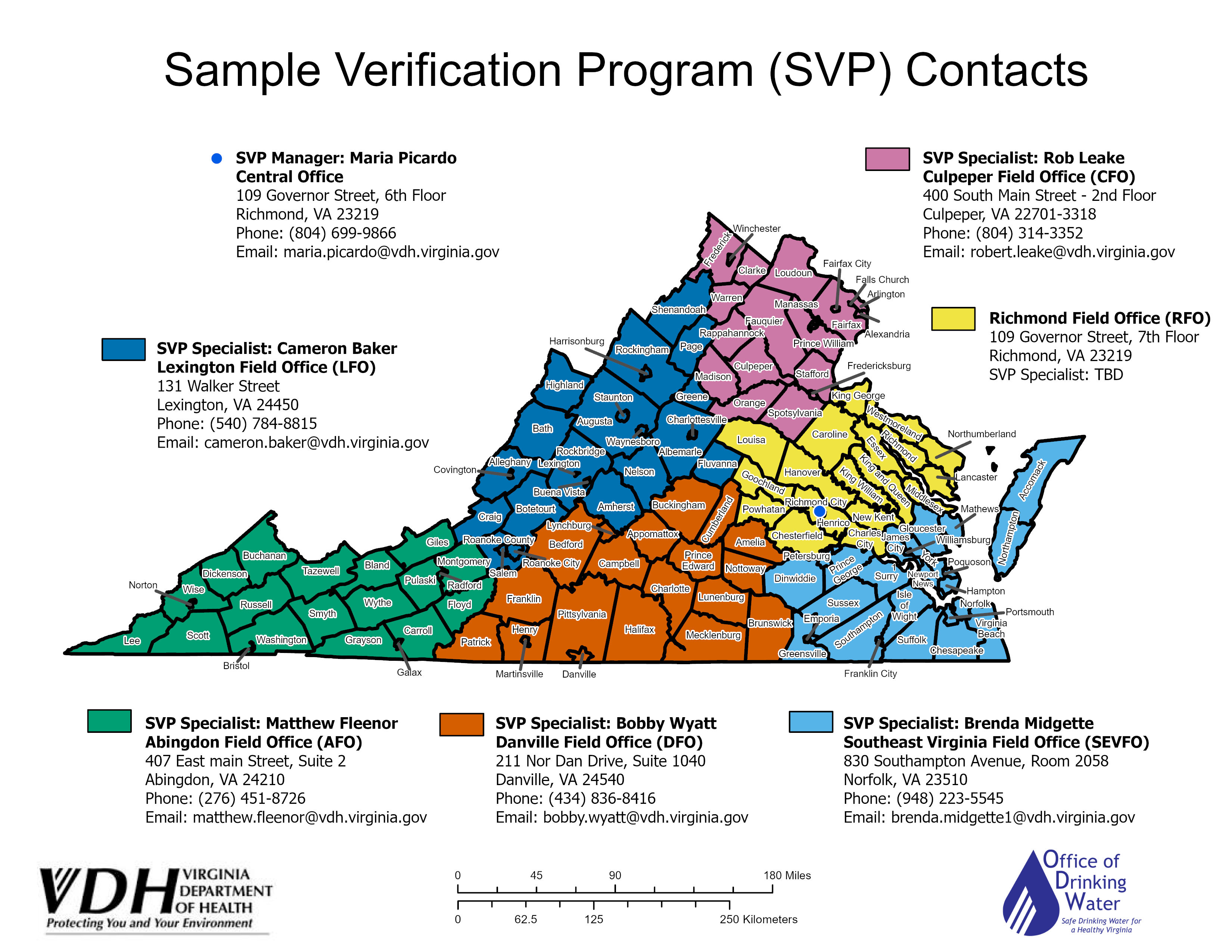
The SVP operates as a central office program led by the SVP manager, with dedicated specialists supporting each of the six ODW field offices.
Program Manager:
Maria Picardo – Central Office
maria.picardo @ vdh.virginia . gov
SVP Specialists:
| Matthew Fleenor – Abingdon Field Office
276-451-8726 |
Cameron Baker – Lexington Field Office
540-784-8815 |
| Rob Leake – Culpeper Field Office
804-314-3352 |
TBD – Richmond Field Office
|
| Bobby Wyatt – Danville Field Office
434-836-8416 |
Brenda Midgette – Southeast Field Office
948-223-5545 |
자주 묻는 질문
SVP checks whether public water systems collect, handle, and report drinking water samples correctly. Inspectors watch sampling in the field, check paperwork, and confirm that labs receive complete and accurate information. SVP 목표 to strengthen oversight, reduce errors, and improve data reliability statewide.
In 2019, the Office of the State Inspector General (OSIG) found that ODW was not fully meeting its responsibility to make sure water‑sampling data was accurate and reliable. To address this, ODW created the SVP 에 strengthen oversight of how public water systems collect, test, and report water samples.
Any public water system in Virginia can be inspected, including community systems, non-transient noncommunity, and transient noncommunity systems. SVP prioritizes systems based on past compliance, sampling history, water source type, population served, and statewide public health goals. Some inspections are routine; others respond to risk.
No. Many inspections are preventive. They help confirm that systems are using correct procedures and allow staff to fix small issues before they become larger problems.
UPS 서비스는 SVP specialist will contact selected waterworks to schedule a 편리한 검사 time. SVP inspections occur during regularly scheduled compliance sampling, so no additional sampling expense is incurred by 그 시스템. Waterworks may be asked to submit documents beforehand, and all required on-site 서류 will be reviewed; additional materials may also be requested during the visit.
The SVP specialist will review sampling procedureS and observe 그 designated sampler 에 확인 proper techniques and identify 어떤 영역 그 5월 need improvement. Water systems 다음 receive feedback from the SVP team and a detailed report. If issues were found, 물 체계 필수 correct them. SVP may follow up to make sure changes are made.
Common issues include incorrect sampling techniques, choosing the wrong sampling locations, mistakes on paperwork, container handling problems, or delays getting samples to the lab. If a serious or repeated issue is discovered, the case may be referred to the enforcement team. Enforcement actions are used to protect public health and ensure rule compliance.
Yes. Training is a major part of the program. SVP staff help operators improve their sampling approach and learn how to avoid common errors. If you are new to sampling, unsure about any part of the process, or need any technical assistance, please 이메일 the program at Sampling.VerificationProg @ vdh.virginia . gov 또는 문의 your regional SVP specialist for support.
SVP results become part of the system’s regulatory record. While SVP does not publish reports directly, information may be shared with ODW field offices and system owners.
Frequency depends on risk, past performance, and statewide needs. Some systems may be inspected more often if issues are found.
By catching errors early, preventing reporting mistakes, and confirming proper sampling, SVP ensures that water quality data is reliable. Accurate data helps ODW respond quickly to any real water quality concerns.